
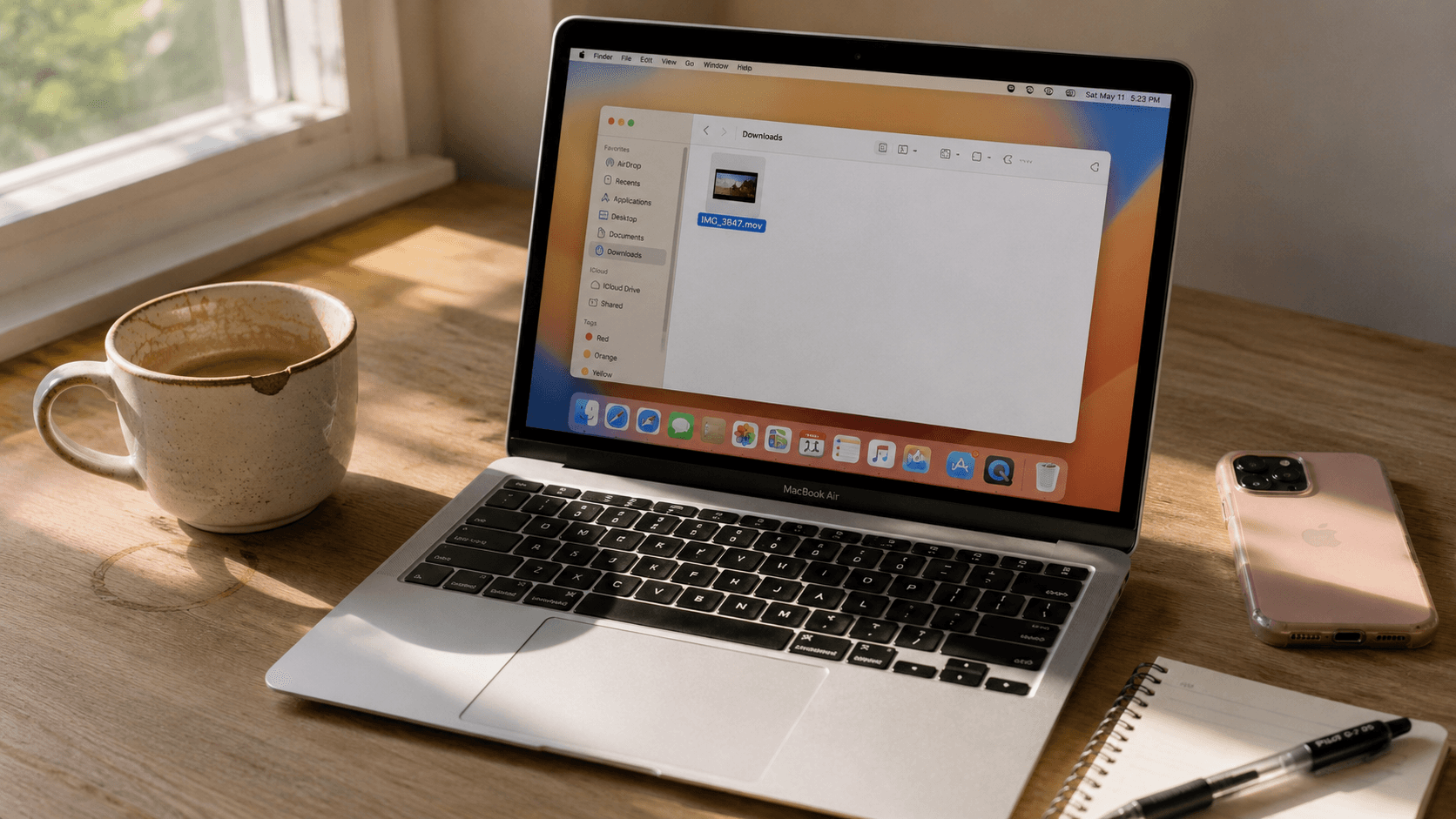
Most posts that answer "how to convert MOV to MP4" miss the most important thing: MOV and MP4 are not different video formats. They are different containers wrapping the same video.
Open an iPhone .mov in any modern viewer and you will almost certainly find H.264 video and AAC audio inside. The MP4 container holds the exact same thing. The two formats differ in metadata structure and atom ordering, not in the actual video data.
For most files, "converting" MOV to MP4 should not change quality at all. The video stream stays bit-for-bit identical; only the wrapper changes. The technical name for this is remuxing.
Real conversion (re-encoding the video) takes minutes and degrades quality. Remuxing takes seconds and is lossless. The difference matters more than any guide on the internet seems to acknowledge.
The Three Methods, In Order of Speed
1. CompressYourVideo (browser, fastest)
Drop your MOV in, pick MP4 as the output format. If your source is H.264 (the most common case for iPhone videos), the tool does a remux. The new file is byte-identical in quality. Done in seconds.
If your source is HEVC (iPhone 12 and newer can record in HEVC by default), the tool re-encodes to H.264 for compatibility. That takes longer. The result plays on Windows, Android, and the web without codec packs.
Nothing uploads. The whole conversion runs in your browser using your device's hardware encoder.
2. QuickTime Player (Mac, native)
If you are on a Mac and just need this once, QuickTime can do the conversion without any extra software.
- 1Open the MOV in QuickTime Player.
- 2File menu, then Export As.
- 3Pick a resolution. Your original resolution is fine.
- 4Save with a .mp4 extension.
QuickTime will re-encode the video, which takes longer and is technically lossy. The visible quality loss is small, but it is not zero. For one-off conversions where you do not care, this is fine.
3. VLC (Windows, Mac, Linux, free)
VLC is the only widely-installed tool that lets you do a true remux through a GUI.
- 1Media menu, Convert / Save.
- 2Add your MOV file.
- 3Click Convert / Save at the bottom.
- 4Pick any MP4 profile.
- 5Click the wrench icon next to the profile to edit it.
- 6Under the Video Codec tab, check "Keep original video track" to remux without re-encoding.
- 7Same for the Audio Codec tab.
- 8Save and pick an output location.
Takes 30 to 60 seconds for a typical phone video. Output is bit-identical to the source.
When MOV Actually Causes Problems
The reason people convert in the first place is usually about playback compatibility, not file size. Here is the real picture in 2026:
| Where you are sending the video | MOV works? | Convert to MP4? |
|---|---|---|
| Windows Media Player (older versions) | Sometimes | Yes |
| YouTube | Yes | No benefit |
| Yes | No | |
| Email attachment | Yes | MP4 is slightly safer for Outlook |
| Adobe Premiere | Yes | No |
| Android phones | Sometimes (depends on codec) | Yes if HEVC inside |
| Discord | Yes | No |
| Slack | Yes | No |
| Modern browsers | Yes | No |
The honest answer: in 2026, MOV plays almost everywhere it needs to. The consistent exceptions are older Windows machines, a few corporate IT environments that filter by extension rather than content, and people doing video editing in tools that prefer one container over another.
The HEVC Trap
Here is where the conversion gets complicated. Since 2017, iPhones default to recording in HEVC (also called H.265) inside a MOV container. HEVC is more efficient than H.264 (about 40 percent smaller files for the same quality), but it has much narrower compatibility:
- Plays on Mac, iOS, and Windows 11.
- Does not play in most browsers without explicit codec support.
- Does not play on older Windows or Linux without codec packs.
- WhatsApp Web will refuse to upload it on Firefox.
If your MOV file is HEVC and you need wide compatibility, you need a real conversion to H.264 inside MP4. This is the one case where the conversion is not a remux. It takes longer and is technically lossy, though the loss is usually invisible at normal viewing distances.
CompressYourVideo handles this automatically. If we detect HEVC, we transcode to H.264 and output MP4. If we detect H.264, we just remux. You do not need to know which you have.
To check what codec your iPhone is using, open Settings, then Camera, then Formats. "High Efficiency" means HEVC. "Most Compatible" means H.264.
Does Converting Make the File Smaller?
Usually not. The video data is the same so the file size is essentially the same, give or take a few kilobytes of container metadata. If you also want to reduce file size, that is a separate operation called compression, where the encoder targets a smaller bitrate.
CompressYourVideo can do both at once: convert MOV to MP4 and shrink to a target size like 16 MB for WhatsApp or 25 MB for Gmail.
Frequently Asked Questions
Will converting MOV to MP4 lose quality? Only if the conversion re-encodes the video. Most iPhone MOV files contain H.264, which can be remuxed into MP4 with zero quality loss. HEVC MOV files have to be re-encoded for H.264 MP4, which is slightly lossy but usually invisible.
Why does my Mac save videos as MOV by default? QuickTime, screen recording, and the Photos app all default to MOV because it is Apple's preferred container. It is essentially MP4 with Apple-flavored metadata atoms. For sharing outside the Apple ecosystem, MP4 is a safer default.
Why won't my MOV play on Windows? Two reasons. Older Windows Media Player did not support newer codecs without third-party additions. Or your MOV is HEVC, which Windows 10 needs a paid codec for. Windows 11 includes it by default.
Can I just rename the .mov to .mp4? Sometimes, yes, if the file is H.264 and AAC. Many players will accept it. But QuickTime metadata atoms can confuse strict players. A proper remux fixes this in seconds and is the safer bet.
Is there a free way to do this without uploading? Yes. CompressYourVideo runs entirely in your browser, the MOV file never reaches any server. VLC also does it locally. QuickTime on Mac too.
TL;DR
Most MOV to MP4 conversions are container swaps that should not lose quality. Use CompressYourVideo for the fastest one-click conversion (it auto-detects whether to remux or transcode), QuickTime on Mac for one-offs, or VLC if you want a true remux through a GUI. If your MOV is HEVC, you will need a real re-encode either way, but the quality loss is usually invisible at normal viewing distances.
The case where you genuinely need MP4 instead of MOV in 2026 is narrower than people think. For most uses, MOV works fine. The exception is older Windows machines and a few corporate email filters.